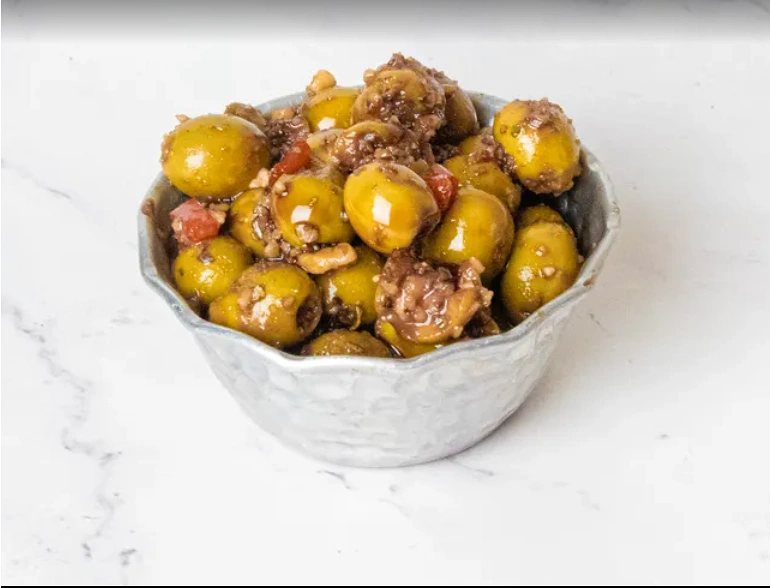
What is Zeytoon Parvardeh?
Zeytoon Parvardeh is a small dish with a big personality. Plump green olives sit overnight in a paste of walnuts, garlic, fresh herbs and pomegranate, and by morning every bite tastes sweet, sour, nutty and a little wild. It comes from Gilan, the lush green province along Iran's Caspian coast, where walnuts and pomegranates show up in almost every kitchen.
At Next Stop Cafe we serve it as a starter on our mezze boards, especially in the long Winnipeg winter when something bright and tangy is exactly what guests want before a heavier main like Koobideh or Ghormeh Sabzi.
Where the dish comes from
Gilan sits between the Alborz mountains and the Caspian Sea. The climate is humid, the rice paddies stretch for miles, and the cooking leans vegetarian in a way most people don't expect from Iran. Dishes like Mirza Ghasemi, Baghali Ghatogh and Zeytoon Parvardeh all carry that same Gilani fingerprint: herbs, garlic, and a sharp note from pomegranate or sour orange.
Traditionally the recipe uses a local herb called chuchagh, which is almost impossible to find outside northern Iran. Most cooks abroad swap in fresh mint, and that's what we do too. A little parsley and coriander round it out without pulling the dish away from its roots.
Ingredients you'll need
The shopping list is short, but quality matters. Cheap olives will fight the marinade instead of soaking it up.
- About 350 g of large pitted green olives (Castelvetrano or Gordal work beautifully)
- 7 whole walnuts, or roughly 14 halves
- 2 cloves of garlic
- 10 g each of fresh mint, coriander and parsley leaves
- 2 tbsp pomegranate molasses, plus 2 tbsp pomegranate juice
- 1 tbsp good extra-virgin olive oil
- A small handful of pomegranate arils, for stirring through and garnish
- A pinch of ground walnuts to sprinkle on top
Chef's tip: taste your pomegranate molasses before you measure. Some brands are sharply sour, others are almost dessert-sweet. Adjust by half a teaspoon at a time until the paste makes you close your eyes for a second.
How to make Zeytoon Parvardeh, step by step
- Drop the walnuts and garlic into a food processor and pulse until the walnuts look like coarse sand.
- Pick the mint leaves off the stems and trim the woody ends from the parsley and coriander. Add the herbs to the processor and pulse again — you want flecks of green, not a smooth puree.
- Pour in the pomegranate molasses, pomegranate juice and olive oil. Pulse two or three times until everything clings together as a chunky paste.
- Tip the olives into a bowl, scrape in the paste, and fold gently. Stir through most of the pomegranate arils and save a few for the top.
- Cover and refrigerate overnight. Twelve hours is the sweet spot; twenty-four is even better.
- Before serving, give it one more stir, scatter the reserved arils and a dusting of ground walnut over the top, and bring it to the table cool, not cold.
How we serve it at Next Stop Cafe
In our dining room on Pembina Highway, Zeytoon Parvardeh lands on the table in a small ceramic dish next to warm sangak bread and a wedge of feta. Most guests reach for it before they realize what's in it. By the time they ask, the bowl is half gone.
If you're planning a dinner at home, it works in three easy ways: as a pre-dinner snack with drinks, as one of several small plates on a Persian mezze, or — our favourite cheat — with sharp cheddar and crackers. Not strictly traditional, but our regulars who first tried it that way keep coming back for more. Curious what else pairs with it? Take a look at our full menu.
Make-ahead and storage
This is a dish that gets better with patience. The olives keep in a sealed jar in the fridge for up to a week, and the flavour deepens every day. If you're hosting, make it on a Saturday morning and serve it Sunday evening — the herbs settle in, the walnut softens, and the pomegranate molasses turns from sharp to mellow.
Hosting something bigger? We build mezze platters with Zeytoon Parvardeh, hummus, mast-o-khiar and warm bread for offices and family events across Winnipeg through our catering team.
Quick FAQ
Can I use pitted black olives?
You can, but the dish loses its signature snap. Green olives carry the sour-salty backbone the marinade needs. Black olives turn it muddy.
Is Zeytoon Parvardeh vegan?
Yes. The classic version has no dairy, no eggs and no meat. It's also naturally gluten-free, as long as your pomegranate molasses doesn't sneak in additives.
What if I can't find pomegranate molasses?
Reduce a cup of unsweetened pomegranate juice with a teaspoon of sugar over low heat until it coats the back of a spoon. It takes about twenty minutes and the result is honest enough for this recipe.
If you'd rather skip the shopping and taste it the way our chef makes it, come sit with us. Reserve a table, or order online and add a side of Zeytoon Parvardeh to your next meal.